
Introduction (Quick Answer)
Clear website design trust is where you begin to build trust, making your business easy to understand, navigate, and engage with. This guide is for local service businesses who want to convert more visitors into clients by building trust through effective website design. For these businesses, website design trust is crucial because it directly impacts whether a visitor feels confident enough to make an enquiry or become a client.
In the context of website design, ‘trust’ means that a streamlined, clear, and well-signposted website builds trust at all levels of the hierarchy of trust. When visitors can quickly see what you do, who you help by understanding and engaging your audience, and how to get in touch, they are far more likely to stay, trust your business, and make an enquiry.
For local service businesses, this is not just a design preference, it directly affects whether a visitor becomes a client. In fact, 75% of a website’s credibility depends on its design, with users forming opinions in seconds.
Why Trust Is the Real Conversion Factor
Most local customers are not comparing dozens of options. They are asking simple questions:
- Does this business look reliable?
- Do they understand what I need, including my personal concerns or requirements?
- Can I contact them and quickly?
If your website feels unclear, cluttered, or confusing, trust drops immediately, even if your service is strong, as shown by extreme examples of bemusing and confusing web design.
Clear design reduces doubt. It creates confidence before a single conversation takes place. Remember, 75% of a website’s credibility depends on its design, with users forming opinions in seconds.
What “Clear Website Design” Actually Means
Clear design is not about minimalism or style trends. It is about removing friction so visitors can understand and act.
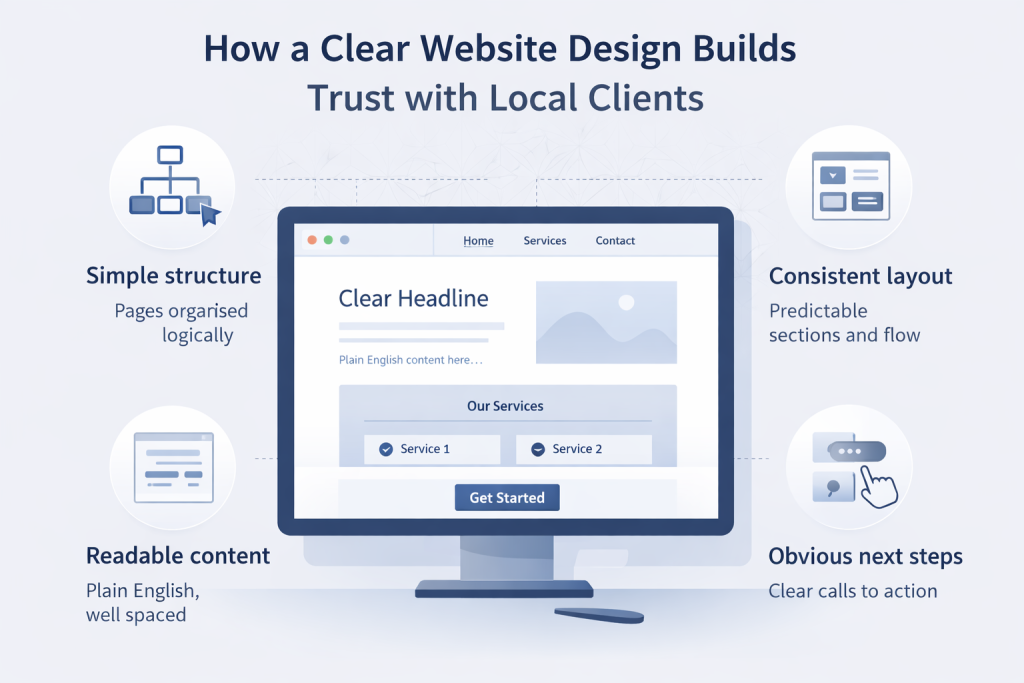
At its core, clarity comes from:
- Simple structure – pages organised logically, a key aspect of web design and web usability
- Readable content – plain English, well spaced
- Consistent layout – predictable sections and flow, which supports effective web design
- Obvious next steps – clear calls to action
Putting these principles into practice in web design is essential for clarity, helping to build trust and improve the overall user experience.
This aligns with how Google describes helpful page experience, content should be easy to use and understand for real people (Google Search Central guidance on page experience and helpful content).
The Key Design Elements That Build Trust
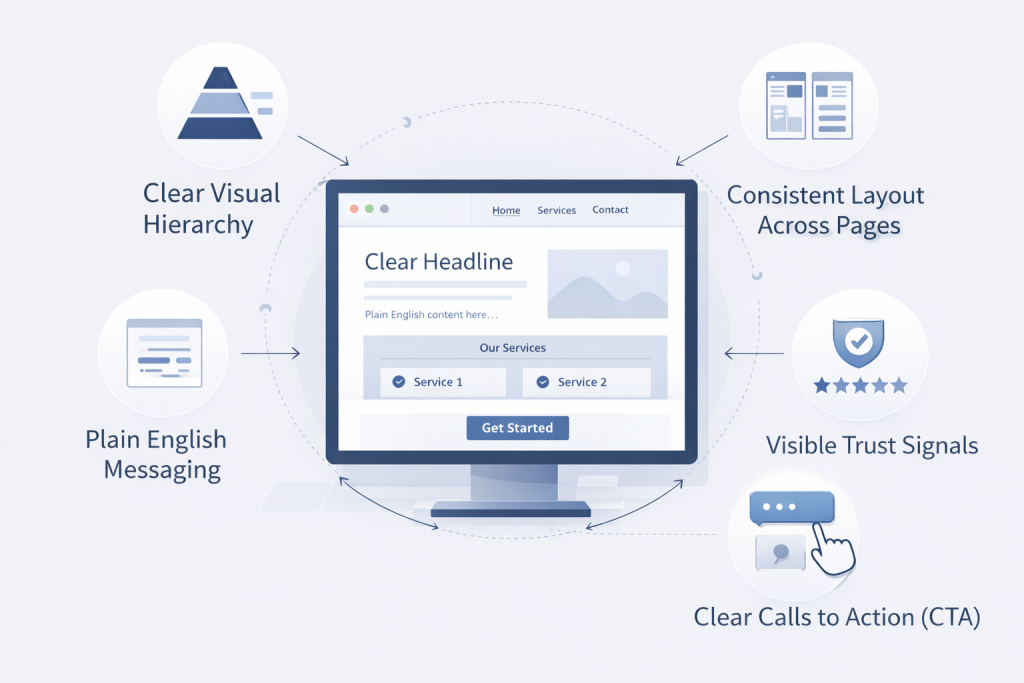
1. Clear Visual Hierarchy
Visitors scan, they do not read everything.
A strong visual hierarchy ensures they see the right things first. Visual hierarchy is created through variations in colour and contrast, scale, and grouping. For example:
- Headline (what you do) bigger elements stand out more and attract more attention
- Supporting message (who it’s for)
- Call to action (what to do next)
Grouping related elements helps readers understand the structure of the page and direct attention to relevant areas. Visual hierarchy predicts user flow by placing important information where readers are most likely to look first. Using typography intentionally can emphasise key information and create a clear hierarchy. White space aids legibility and balances the visual hierarchy by preventing clutter, making it easier for readers to absorb information.
A well-executed visual hierarchy improves usability, readability, and overall user experience by guiding users toward specific goals or messages. As a practical tip, use visual cues such as prominent buttons or a clear logo to guide attention and help visitors navigate your site more easily.
If everything looks equal, nothing stands out.
2. Plain English Messaging
Overly complex language creates distance.
Clear, straightforward wording:
- Reduces confusion
- Speeds up decision-making
- Makes your business feel approachable
For local businesses, clarity often outperforms creativity.
3. Consistent Layout Across Pages
When every page feels different, users lose confidence.
Consistency in:
- Headings
- Spacing
- Colours
- Button styles
…signals professionalism and stability.
4. Visible Trust Signals
Design should support credibility, not hide it.
Key elements include:
- Client testimonials
- Real business address or service area
- Portfolio or case studies
- Clear contact details
- Personal or team information to build personal connections with visitors
- Secure handling of customer data
These trust signals are intentionally created to foster credibility and reassurance for your visitors. Displaying authentic imagery of your team or business, rather than generic stock photos, helps humanise your brand. High-quality images throughout your website further enhance the perception of your business and build trust. Providing clear and accessible contact information is essential for establishing confidence and making it easy for people to reach you.
These should be easy to find and not buried.
5. Clear Calls to Action (CTA)
Even if someone trusts you, they still need direction.
Effective CTAs are:
- Visible
- Specific (“Request a Quote”, not “Submit”)
- Repeated at key points
Without this, enquiries drop, even on well-designed sites.
Now, let’s look at how these principles work in practice.
Case Studies and Examples of Trust-Building Design
Building trust online comes down to fundamentals, how your website feels when someone visits matters just as much as what it says. For local businesses in Notting Hill and beyond, getting the basics right creates confidence and helps visitors understand what you do.
Visual Hierarchy in Action
Visual hierarchy guides people through your content properly. Clear headings, sensible font sizes, and thoughtful spacing show visitors what matters most on each page. Whether that’s your main service, contact details, or how to get in touch, good hierarchy removes guesswork. A homepage with a straightforward headline, supporting detail underneath, and a clear “Request a Quote” button or simple contact form tells people what you offer and how to reach you. Simple, but effective.
Website Maintenance and Security
Regular website management and maintenance protects both you and your visitors. Security issues, broken links, or unaddressed negative reviews create doubt before anyone even speaks to you, just as a poorly maintained site undermines the work of even the most experienced WordPress web design team. Checking your site regularly for these problems keeps it secure and working properly. This steady approach also supports your search engine performance, which means the right people find you when they’re looking.
Visual Cues and Consistency
Visual cues work as reliable signposts. A recognisable logo, consistent colours, and clear navigation help visitors feel they’re dealing with an established business rather than something thrown together. Quality images and consistent messaging throughout your site reinforce this impression of reliability.
SEO, Digital Marketing, and Social Proof
Search engine optimisation, email marketing campaigns and broader digital marketing support this foundation. When your website SEO and optimisation are handled well and your site appears in relevant searches while presenting a clear, professional image, people feel more confident that your business is established and trustworthy. Well-written case studies and a strong web design portfolio of past projects provide further evidence of your track record and commitment to quality work.
Research and Real-World Results
Research supports these practical choices. Studies from organisations like the Nielsen Norman Group show that professional websites with clear, simple layouts and strong visual hierarchy earn more trust than cluttered or inconsistent ones. A local Notting Hill business that simplified its homepage around one clear message and added a straightforward contact form saw more enquiries and better feedback as a result.
Common Design Mistakes That Reduce Trust
Many local business websites struggle not because of missing features, but because of avoidable issues:
- Too much information on one page
- Inconsistent fonts and colours
- Generic stock imagery with no context
- Hidden or unclear contact options
- Overly complex navigation
Each of these creates hesitation, and hesitation reduces enquiries.
How Clear Design Impacts Local Enquiries
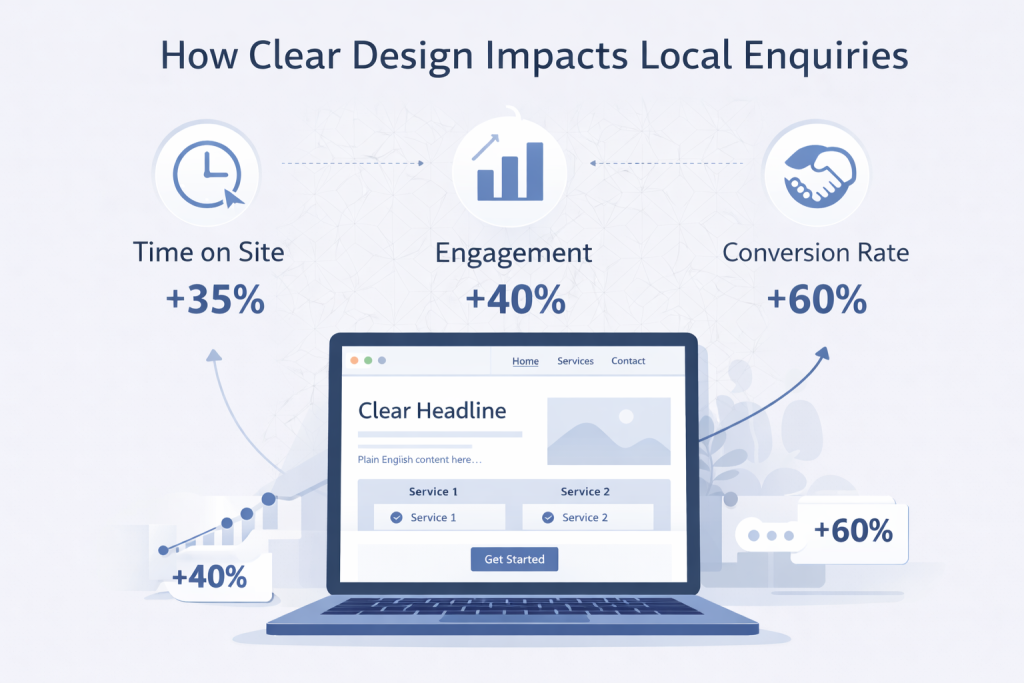
Clear design improves:
- Time on site – users stay longer
- Engagement – more pages viewed
- Conversion rate – more enquiries
Local companies benefit from clear website design through increased trust and more enquiries. Websites that are easy to navigate and user-friendly help establish trust with visitors.
This is not about design preference. It is about how easily a potential client can move from:
“I’ve landed on your site” → “I trust this business” → “I’ll get in touch”
A Practical Way to Assess Your Own Website
You can quickly test clarity by asking:
- Can someone understand what you do in 5 seconds?
- Is your contact option visible without scrolling too far?
- Does every page guide the user to the next step?
- Does the design feel consistent across the site?
If any answer is “no”, clarity and trust, may be limiting your enquiries.
For any issues you identify, seek expert advice on practical steps to improve your website’s clarity and build greater trust with your visitors, ideally from a specialist local web design agency.
Why This Matters More in 2026
As search evolves, especially with AI-driven results, your website is often:
- The first validation point after discovery
- A source of truth for your business credibility, and operating a clear and trustworthy website will be essential for maintaining credibility in the future
If your site appears unclear or inconsistent, it weakens trust, even if you are visible in search.
Clarity is no longer optional. It is foundational.
How Notting Hill Biz Approaches Website Design
Our Approach to Website Design
At Notting Hill Biz, website design is not treated as a one-off visual task.
We focus on:
- Clear structure and messaging
- Practical layouts that support enquiries
- Long-term usability and consistency
- Ongoing refinement after launch
This reflects our wider approach, building websites that are created with the intention of supporting real business activity, not just appearance, whether that is lead generation for local services or effective WooCommerce e‑commerce sites.
Conclusion
Clear website design builds trust by making your business easy to understand, navigate, and engage with.
For local service businesses, this directly affects whether visitors become enquiries.
Small improvements in clarity, layout, messaging, structure, often lead to measurable increases in trust and conversions.
Summary Checklist: How Can I Make My Website Design More Trustworthy?
- 75% of a website’s credibility depends on its design, with users forming opinions in seconds.
- A cohesive brand identity fosters trust with customers through effective web design.
- Websites that are easy to navigate and user-friendly help establish trust with visitors.
- A secure and technically sound website is a proven way of gaining the trust of potential customers for your business.
- Providing clear and accessible contact information on a website enhances trust with visitors.
Use this checklist to review your website and ensure you are building trust at every step.
Behind the Scenes: How We Ensure Accuracy, Expertise and Transparency

About the Author
Nitya Tripathi is the Creative Director at Notting Hill Biz, with over 15 years of design experience and more than a decade with the company. He specialises in creating clear, practical design solutions that support real business outcomes for small and medium-sized businesses.
Having worked across industries including health, finance, fashion, and global sports brands, Nitya brings a broad perspective to website design and visual execution. He focuses on combining strategic thinking with strong, engaging design to ensure each project is both effective and aligned with business goals.
Outside of work, Nitya enjoys cooking, spending time in nature, and being with his family.